
Behind a lasting smile, there is a quality retainer.
Your orthodontic treatment is coming to an end, or you are preparing for it. Retention is the step that will protect your new smile over time.
Here is everything you need to know to approach this phase with confidence.
What is a fixed retainer?
A fixed orthodontic retainer is a thin, invisible wire bonded to the inner surface of your teeth, discreet, painless, and far more sophisticated than you might think.
Why is it needed?
During your orthodontic treatment, your teeth have been moving. Once your braces or aligners are removed, your teeth naturally tend to want to keep shifting..
This is perfectly normal. It is due to the memory of the tissues surrounding your teeth, such as the ligaments and alveolar bone, which need time to stabilise. A fixed retainer holds your teeth in place during this period, which can last several years.
It is your orthodontist who assesses the need for retention and determines the most appropriate type for your clinical situation.
Does it hurt?
Placement is painless. Your orthodontist bonds the wire to the inner surface of your teeth, in the same way as for braces.
You may experience slight discomfort in the first few days as your tongue adjusts, but this sensation disappears very quickly.
If you experience persistent or unusual pain, speak to your orthodontist.
How long do you keep a fixed retainer?
The duration depends on your clinical situation and your orthodontist's recommendation.
In most cases, the retainer is worn for several years, though long-term retention may be necessary depending on your individual clinical characteristics.
Only your orthodontist can determine the right duration for your situation.
How do you care for a fixed retainer?
A fixed retainer requires thorough oral hygiene.
The wire can trap plaque and tartar, particularly at the junction between the wire and the teeth and in the interdental areas. Careful brushing twice a day, combined with interdental brushes or a special floss threader, helps maintain good hygiene and limit tartar build-up.
Your orthodontist can advise you on the most suitable tools and technique for your retainer.
Fixed retention has come a long way
Technological advances have made it possible to develop retainer wires that are increasingly fine, resilient and adapted to each patient's morphology. This makes fixed retention more discreet, more comfortable and clinically more effective.
Your orthodontist regularly keeps up to date with clinical developments and new technologies in order to offer you the most appropriate retention solution for your clinical needs.
Fixed wire or clear retainer?
There are two types of orthodontic retention. Your orthodontist will determine the most appropriate solution for your situation, and the two can also be combined.
The fixed retainer wire
The fixed retainer wire is permanently bonded to the inner surface of your teeth.
Once in place, there is nothing for you to do, it works continuously, without you having to think about it. It is quickly forgotten, particularly with modern fine wires that fit precisely to the morphology of each tooth.
Its main advantage is its discretion and day-to-day effectiveness as it does not rely on your compliance. On the other hand, it requires thorough oral hygiene and regular check-up appointments to ensure it remains properly in place.
The clear retainer
The clear retainer is a transparent plastic splint that you wear regularly, typically at least overnight.
It is virtually invisible when worn and requires no special dental hygiene beyond your usual brushing routine.
Its main advantage is ease of maintenance. However, its effectiveness depends entirely on your compliance and consistency, a clear retainer that is not worn does not protect your result. It also serves as a useful indicator: if it no longer fits correctly, it is a sign that your teeth have moved and you should consult your orthodontist promptly.
Both at the same time?
The two solutions can be combined..
The fixed wire handles day-to-day retention, whilst the removable retainer provides overnight retention and allows regular monitoring that nothing has shifted.
Your orthodontist's decision
In all cases, it is your orthodontist who determines which type of orthodontic retention is appropriate for your clinical situation.
What is an orthodontic relapse?
Even with a quality retainer, there is no such thing as zero risk. Understanding this phenomenon helps you prevent it more effectively.
Orthodontic relapse refers to unwanted tooth movement after the end of active treatment.
Having been moved during active treatment, your teeth retain a natural tendency to keep shifting, sometimes for many years after treatment ends.
This phenomenon is well documented in orthodontic literature. It can occur even with a quality retainer, as it depends on many factors that neither your orthodontist nor your retainer can fully control : bone growth, changes in your dental morphology with age, your chewing habits, or the pressure your tongue exerts on your teeth.
A well-fitted retainer, worn correctly and monitored regularly, significantly reduces this risk but does not eliminate it entirely. This is why check-up appointments with your orthodontist remain important even after your active treatment has ended.
If you notice that your clear retainer no longer fits correctly, that your fixed wire has come loose, or that you can feel your teeth have shifted, consult your orthodontist without delay. The earlier relapse is detected, the easier it is to correct.
Who we are ?
WinnoveMED is a French medtech startup based in Rennes, Brittany, specialising in the design and manufacturing of custom orthodontic retainers. Our mission: to improve the therapeutic outcomes of orthodontic treatments through technology.
We are a team of engineers with a passion for orthodontics. Since 2020, we have been developing technology solutions to help orthodontists offer their patients the best custom fixed orthodontic retainers available.
Our platform combines a clinical design AI, a patented manufacturing robot and an intuitive ordering interface, so that every retainer is designed and manufactured to the same clinical standard, for every patient, without exception.
We work in close collaboration with orthodontists and leading clinical institutions such as AP-HM and AP-HP, to continuously drive forward the quality and reliability of our retainers..
To date, over 30,000 smiles have been preserved thanks to our retainers, placed by more than 250 partner orthodontists across France and beyond.
Our belief is simple: behind every lasting smile, there is a quality retainer.And behind every quality retainer, there are committed engineers.
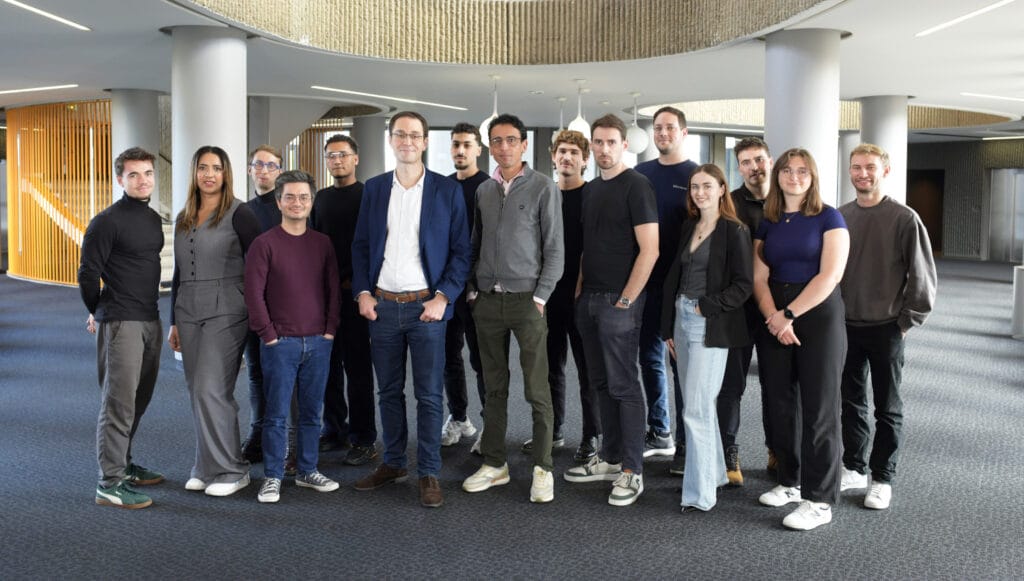
They believe in our mission







FAQ
What is a fixed orthodontic retainer?
A fixed orthodontic retainer is a custom-made medical device bonded to the inner surface of the teeth (lingual side) at the end of orthodontic treatment. It is typically applied to the front teeth (anterior segment), most commonly from canine to canine, on both the lower (mandibular) and upper (maxillary) arches.
Its purpose is to hold the teeth in their new position while they stabilise, as teeth naturally tend to shift in the months following the end of active treatment.
Only an orthodontist can determine the need for a fixed retainer based on the clinical characteristics of the treatment.
Why is retention needed after orthodontic treatment?
Active orthodontic treatment moves the teeth but does not immediately stabilise the surrounding tissues (particularly the ligaments), which need time to reorganise around the new tooth positions.
Without retention, teeth may gradually drift back towards their original position, partially or fully. This is known as relapse.
Retention is therefore the stage that safeguards the long-term outcome of months or years of active treatment.
Only an orthodontist can determine the need for a fixed retainer based on the clinical characteristics of the treatment.
What is the difference between a fixed retainer and a removable aligner?
A fixed retainer is typically a thin wire bonded to the inner surface (lingual side) of the front teeth. The key advantage is that the patient benefits from continuous, long-term retention without having to think about it.
A removable retainer is a clear plastic splint that the patient must wear regularly, typically at least overnight. It retains all teeth (both anterior and posterior segments) but requires significant long-term compliance.
The two can be combined: the fixed wire handles day-to-day retention of the anterior segment, while the removable aligner retains the posterior segment overnight and also serves as a periodic check, if it no longer fits, it is likely a sign that relapse is under way.
It is your orthodontist who assesses the need for retention and determines the most appropriate type for your clinical situation.
Who is behind WinnoveMED ?
WinnoveMED is a French medtech startup founded in 2020 in Rennes by Firas Harrabi, a mechanical engineer and PhD in mechanical orthodontics and member of the Société Française d'Orthopédie Dento-Faciale, and Damien Charalabidis, a digital modelling engineer and seasoned manager.
The team, made up predominantly of engineers, has developed the first complete design and manufacturing platform for custom fixed orthodontic retainers, in partnership with numerous orthodontists and French university hospitals. It combines a clinical AI iForm™, a patented bending robot NovaBend™, and augmented reality placement assistance.
Behind WinnoveMED stand BPI France, the Région Bretagne, French Tech Rennes Saint-Malo, the CIC and Crédit Agricole — all of whom believed in our mission and have supported us from the very beginning.
How much for a retainer made by WinnoveMED ?
WinnoveMED retainers are custom medical devices (CMD).
As such, pricing is not publicly disclosed, in accordance with the regulations governing communication on medical devices.
For any pricing enquiry, please contact your practitioner directly. If you are an orthodontist, you may submit a quote request to our team at 02 44 84 86 44 or by email at sales@winnovemed.com.
What should I do if my wire comes loose or breaks?
If your retainer wire comes loose or breaks, contact your orthodontist as soon as possible.
Do not attempt to reattach it yourself. The sooner you are seen, the lower the risk of your teeth shifting.
In the meantime, avoid hard or sticky foods that could make the situation worse.
Can I eat normally with a fixed retainer?
Yes, in the vast majority of cases.
A few precautions are however recommended: avoid very hard or sticky foods that could put excessive pressure on the wire or cause it to debond.
Your orthodontist will give you tailored dietary advice at the time of placement.
Are there differences between the fixed retention solutions available?
Yes.
There are significant differences between the fixed retention solutions available on the market, in terms of materials used, manufacturing precision, adaptation to each patient's dental morphology, and day-to-day comfort. These differences have a real impact on the clinical effectiveness and long-term durability of the retainer.
Your orthodontist regularly keeps up to date with developments in the field and will choose the most appropriate solution for your clinical situation. Do not hesitate to ask them about it at your next appointment.
